
Heritage
The Kairouani Calligraphyالخط القيرواني
Project narrative
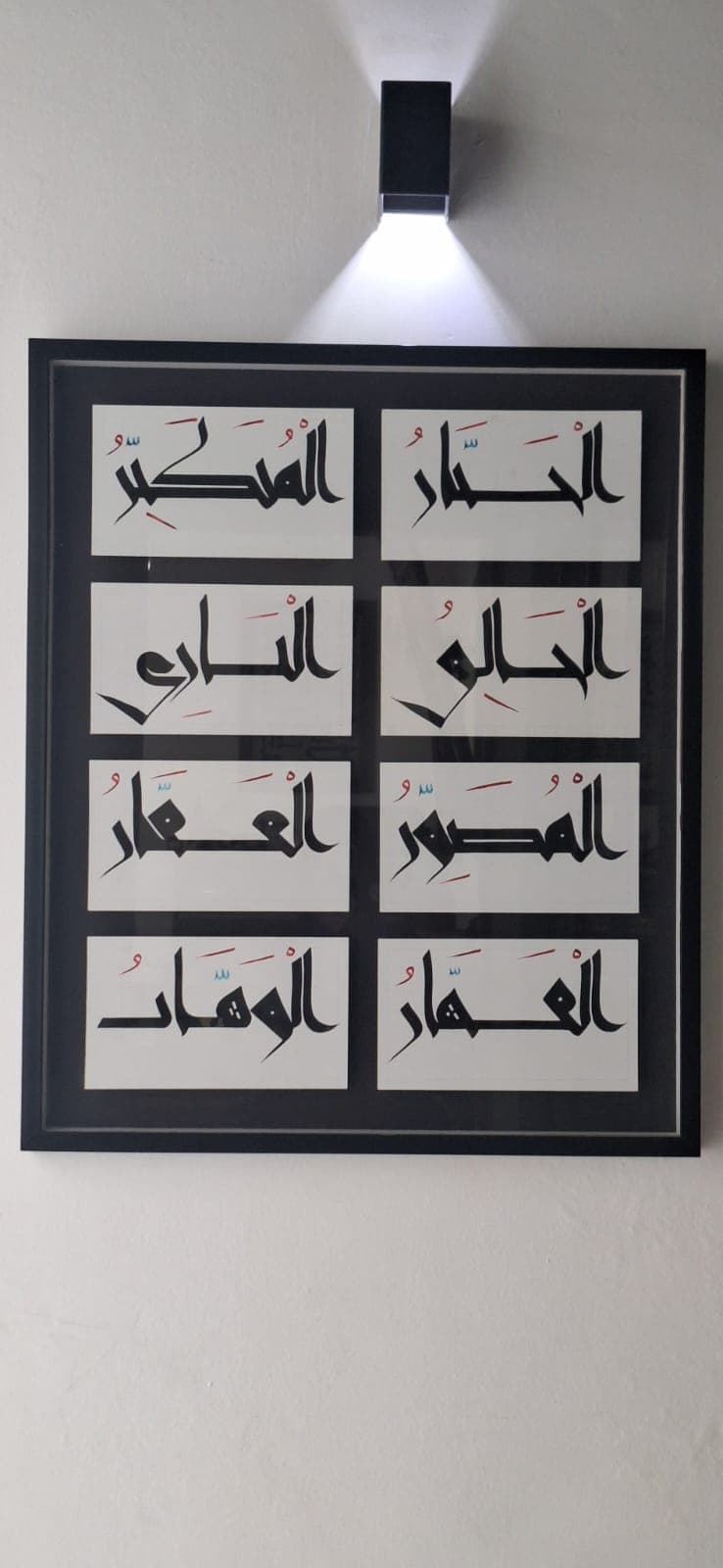
A rare example of Kairouani calligraphy on display: eight compositions in the distinctive Maghrebi script, framed as a contemporary heritage piece celebrating Tunisia’s written tradition.
This artwork is available at Dar Ben Gacem Kahia.
The Kairouani calligraphy is a unique feature in Arabic calligraphy and Islamic art. The “invention” of this rare and bold script goes back to the 10th/11th Century. It can be attributed, with little doubt, to the mediaeval city of Kairouan, at the culmination of its glorious times. A rare and outstanding example of this calligraphy style can be found in a magnificent Qur’an manuscript dating from the 11th Century that is today preserved at the National Museum of Islamic Art in Raqqada, near Kairouan.
The history of this Qur’an manuscript – known as Qur’an al-Hadhina, or the Qur’an of the Nurse – can easily be dated and traced thanks to original legal deed texts that are enclosed in each part of the manuscript. These texts tell us that the manuscript was written, decorated and gilded in 410 AH (1019/1020 A.D.) by a calligrapher named Ali Ibn Ahmed al-Warraq for a woman named Fatima who is the caretaker (or nurse) of the Zirid prince, Al Moez Ibn Badis. The texts also indicate that another woman – referred to as Dora the scribe – was involved in the production of this manuscript. Finally, the deed texts tell us that Fatima donated the manuscript to the Mosque of the city of Kairouan. This is how we know that this masterpiece of Arabic calligraphy was produced in Kairouan a thousand years ago and has never left the library of its mosque until the 1950s.
The Tunisian Association for the Art of Calligraphy has been working on introducing this script in its curriculum and activities since 2017. Training courses and workshops were organized at Dar Al Harka, with the help and assistance from Dar Ben-Gacem. This calligraphy program has received a very positive response from calligraphers and students from Tunisia, France and other Arab countries.
In order for the vision to be successful, the exhibition celebrating the fifth edition of Tunisian Calligraphy 2017 was dedicated to the Kairouani script. For this show, a number of Tunisian eminent calligraphers as well as new talents presented distinctive paintings featuring the Kairouani script. Among the participants to this exhibit, we count Alhassoumi Zeitoun, Najjet Al Nouri and Zohour El Arfawy.
The Association’s second achievement was to digitalize the Kairouani letters and to compose a typo that can be inserted and used on any Microsoft Word-based processing software. The beta version of this Kairouani typo script was distributed to calligraphers, specialists of the field, as well as a group of designers to be tested and assessed. Adjustment work followed the feedback and observations received. The digitalization, testing and the publication of the Kairouani typo was facilitated and financed with an active partnership with company Blue Fish.
It is to be highlighted that Tunisian calligraphy masters Omar Al Jemni, Tarek Abid, Mokhtar Ali and Mohamed Anouar Al Trabelsi took part in this project of revival of immaterial heritage. In addition to the calligraphy techniques and writing aesthetics, subjects such as fabrication of ancestral inks and reeds and parchments, and book making art were discussed during the workshops.
The calligrapher Omar Ben Jeddou, for example, worked on reshaping the writing standards, letter measurements and word-joining techniques, based on his recitation of the Qur’an. The parallel between writing movements and recitation techniques proved to be a valuable asset in understanding the calligraphy of the sacred text.
It is noteworthy that the community of Tunisian calligraphers counts eminent calligraphy masters who are recognized internationally and regionally. For example, Kamal Al Bahri, who has taught Kairouani calligraphy at the National Centre for the Art of Calligraphy for several years, has earned prizes on three different occasions during international competitions organized by the Research Center for Islamic History, Art and Culture (IRCICA), Turkey.
The re-emergence of Arabic calligraphy in contemporary Middle Eastern arts and crafts is now an established trend. However the use of the Kairouani, and of other Maghrebi North African calligraphy styles, is still timid and exclusive. Hints of local scripts can be witnessed in Tunisian contemporary fine arts from the last decades but Tunisian artists, designers and artisans seem more attracted to the Eastern, Turkish and Iranian scripts than to the historically rooted styles.
The reasons behind these preferences can be attributed to the lack of knowledge of the local written heritage and to the weakness or unavailability of digital tools that graphical “influencers” can use. This project’s goal is to revive a local script and to reintroduce it in the contemporary public iconography. By providing a free and open digital tool (a typo) to graphic design professionals and amateurs alike, by showing examples of the script used in more secular, modish and urban contexts, and by featuring calligraphy compositions on a collection of groovy outfits, a trend can be set! The millennial script is offered a re-birth and (why not?) a future.
Sihem Al Amine
TEAMفريق العمل
PROJECT COORDINATION & EXECUTIONفريق إدارة المشروع والتنفيذ
Leila Ben-Gacem, project design and funding
ليلى بن قاسم، تصميم وتمويل
Sihem Al Amine, historical and font specifications coordinator
سهام الأمين، تنسيق بين الخط والتصميم
Dhafer Ben Khalifa, product design coordinator
ظافر بن خليفة، إدارة تقنية وتصميم منتجات
Marouan Zbidi, digital and communications coordinator
مروان زبيدي، إدارة رقمية وإعلام
Imen Wannen, project logistics
إيمان ونان، إدارة لوجيستية
PARTICIPATING CALLIGRAPHERSالخطاطون المشاركون
Mokhtar Ali, master calligrapher
الخطاط مختار علي، أستاذ خط
Mohamed Anouar Trabelsi, master calligrapher
الخطاط محمد أنور الطرابلسي، أستاذ خط
Mokhtar Matmati, master calligrapher
الخطاط مختار المطماطي، أستاذ خط
DIGITALISATION OF KAIROUANI CALLIGRAPHYحوسبة حروف الخط القيرواني لاستعمالها في معالجة النصوص
Abdelsalem Bejaoui, president of the Tunisian Association of Calligraphic Arts
عبد السلام بجاوي، رئيس الجمعية التونسية لفنون الخط
Mohammed Dridi, programming engineer
محمد الدريدي، مهندس إعلامية مختص في البرمجيّات
Mokhtar Matmati, calligraphic design advisor
المختار المطماطي، خطاط ساعد على البرمجة
CALLIGRAPHERS WHO PRODUCED KAIROUANI COMPOSITIONS FOR TUNISIAN ARTISAN MEDIAالخطاطون الذين أنجزوا تراكيب بالخط القيرواني، بالتنسيق مع فريق التصميم، لاستغلالها بمحامل الحرفيين التونسيين
Mokhtar Ali, calligrapher
الخطاط مختار علي
Mohamed Anouar Trabelsi, calligrapher
الخطاط محمد أنور الطرابلسي
Mokhtar Matmati, calligrapher
الخطاط مختار المطماطي
DOWNLOAD KAIROUANI FONT
تحميل الخط القيرواني
Download the Kairouani typography file (AL-Qairwan) for use in text processing.
Download the fontQuestions about this project? info@bluefish.me